
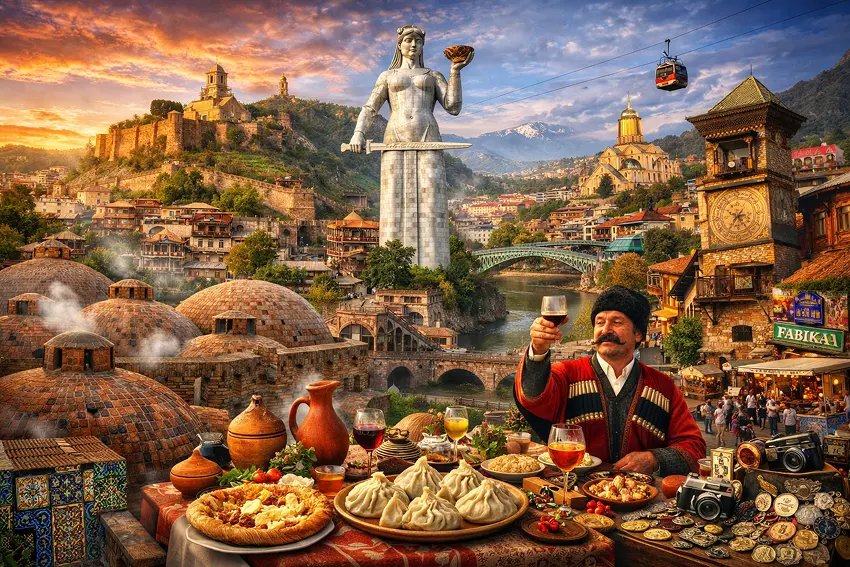
You arrive in Tbilisi with assumptions. Everyone does. You expect a regular European capital – some planned structure, predictable monuments, maybe a quiet river running through. But the city instantly, violently, shatters that whole idea. This isn’t just “historic,” a static place. It is a chaotic, gorgeously layered, totally intoxicating visual paradox. A place holding the 5th century and the fiercest contemporary culture in sharp, clashing tension. It’s overwhelming, yes. You smell sulfur – actual sulfur from springs thousands of years old – mingling with fresh-baked bread. You walk past houses that fuse Persian tilework with Venetian balconies. It is sensory overload, demanding immediate, deep immersion.
To truly, honestly comprehend Tbilisi – and you must – setting aside any standard, predefined tourist schedule is paramount. This city cannot be rushed. The only approach, really, is an attitude of patient, deliberate presence, letting the place register itself as a sequence of intense, unfiltered, often utterly contradictory moments. That’s the core requirement.
Triprents: Rent a car in Tbiisi
The Foundation: Sulfur, Stone, and Survival
The entire city exists because of heat. That foundational energy is anchored right there, in the Abanotubani district. The sulfur baths are not a spa; they are a necessary, visceral pilgrimage. Those low, distinctive, domed brick structures, often covered in tilework, are the absolute core of the city’s identity, linked to its very founding myth.
Overlooking this thermal heart is the Narikala Fortress, a massive stone sentinel since the 4th century. The ascent – climbing up, or taking the quick cable car – is absolutely essential. From the ramparts, the view encapsulates Tbilisi’s tumultuous past: a coveted, critical strategic position that survived successive waves of Arabs, Persians, and Byzantines through sheer, unyielding defense.
The Spirit: Sword and Wine
Guarding the city on Sololaki Hill stands Kartlis Deda (Mother of Georgia). She holds two dramatically contradictory objects: a bowl of wine for friends, a sword for enemies. This powerful, enduring duality—fierce defense paired with that legendary, legendary hospitality – is the absolute national psyche.
This spirit is matched by faith. While the colossal Holy Trinity Cathedral (Sameba) is a massive, modern declaration, the true spiritual resonance often feels stronger in the tiny, ancient, moss-covered chapels hidden deep in the Old Town. In these dark, incense-heavy spaces, one feels the immediate, palpable, unbroken cultural endurance of Georgia.
The Buzz and the Blends
Tbilisi’s lasting appeal is completely tied to how its distinct neighborhoods violently collide.
The Old Town is a necessary starting point, with its winding, cobbled streets and those elaborate carved wooden balconies. You must get lost here. Look for the charming, tilting Gabriadze Theater Clock Tower.
But the energy changes completely across the river. Head to Marjanishvili—it feels distinctly Central European, a clear legacy from early German settlers. Yet, mixed right in are strong Turkish and Arabic cultural influences. It manages to feel simultaneously polished and incredibly complex.
For the contemporary edge, go directly to Fabrika. This former Soviet-era factory has been brilliantly repurposed – hostel, bars, studios – its courtyard covered in vibrant street art. It is the literal hub where the city’s modern, independent spirit congregates.
For material history, the Dry Bridge Flea Market is mandatory. It’s a chaotic bazaar of old Soviet medals, vintage cameras, and countless curious objects, offering a tangible, immediate link to Georgia’s complicated, layered past.
The Feast: The Ritual of Supra
No visit is complete without willingly surrendering to the Georgian table. Dining here is never simple, quiet sustenance; it is a profound, communal, almost ceremonial event that absolutely defines their culture.
Georgia is the cradle of wine (a tradition spanning 8,000 years). You must sample the indigenous amber wines – they are earthy, complex, and unlike anything else you’ve tasted.
The food is essential: Khinkali (soupy dumplings – you have to slurp the broth first). And Khachapuri, the glorious, endless forms of cheese-filled breads.
The proper Georgian meal is the Supra, or feast, overseen by a Tamada (toastmaster). The wine flows, and the toasting becomes a highly elaborate, intensely sincere art form focusing on universal concepts like peace, friendship, and family. It is an overwhelming, beautiful, unforgettable display of national hospitality.
Practical Notes
Navigating is actually easy. Get a Metromoney card (it works for the metro, buses, cable cars). For taxis, always use apps (Bolt or Yandex Go) for fair, fixed pricing. Safety is generally very high. The local currency is the Lari (GEL). Always carry some Lari; cash is prudent outside major venues.
Check useful information for tourists
Tbilisi is ultimately far more than a simple destination. It is a powerful, demanding cultural immersion that absolutely requires engagement on its own complex, magnificent, and often unpredictable terms. You will depart feeling integrated into the heart of a resilient, ancient, and utterly unforgettable culture.