
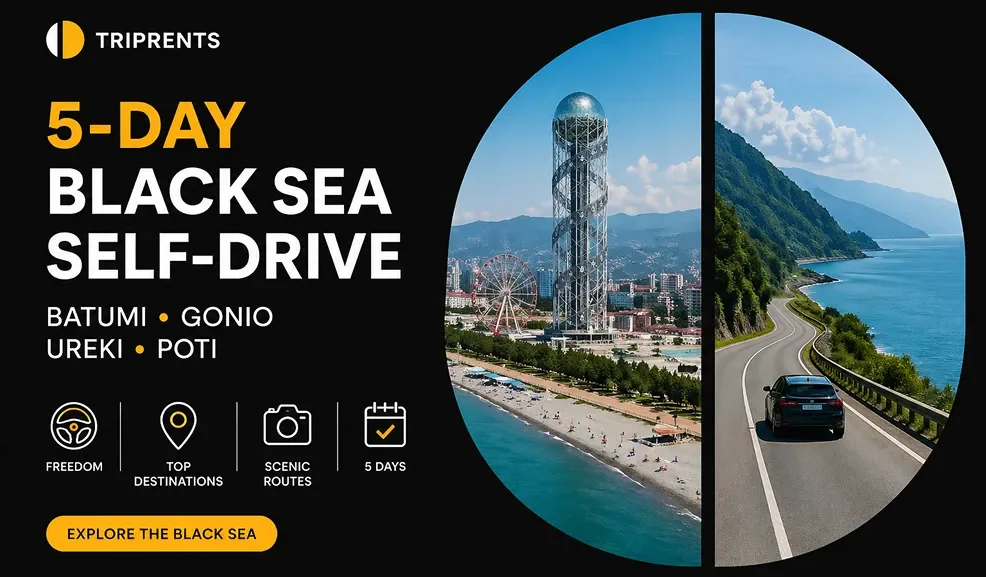
There is a specific moment when you’re driving from the center of Georgia toward the coast where the air simply changes. The dry, dusty heat of the Tbilisi basin gives way to a heavy, salt-flecked humidity that smells like eucalyptus and adventure. This 5-day self-drive isn’t just about getting to the water; it’s about the transition from the rugged Caucasus heartland to the subtropical neon pulse of the Black Sea.
Before You Leave Tbilisi
Optimal departure time for coast arrival
If you leave Tbilisi at 10:00 AM, you are making a tactical error. You’ll hit the Rikoti Pass bottleneck just as the heavy trucks are gasping up the incline. To “win” the drive, aim for a 5:30 AM or 6:00 AM departure. The city is ghost-quiet, the air is cool, and you’ll reach the scenic sections of the highway before the sun begins to bake the asphalt. An early start ensures you aren’t just arriving in Batumi; you’re arriving in time for a slow, celebratory lunch rather than a frantic check-in.
Packing: beach + city + mountain micro-loops
Packing for the Georgian coast is a game of three halves. You need your beach essentials (swimwear and high-SPF sunscreen, as the Adjarian sun is deceptively strong), but Batumi is a “dress-up” city. You’ll want something sharp for the rooftop bars. Crucially, don’t forget a light windbreaker or fleece. If you take a detour into the Machakhela valley or up to the Goderdzi pass area, the temperature can drop 10°C to 15°C in under an hour. A pair of sturdy sneakers is non-negotiable for the slippery stones of the Makhuntseti waterfall.
Fuel strategy for the long east-west stretch
While gas stations are frequent, the stretch through the Zestafoni-Kutaisi corridor can be unpredictable with construction. Fill your tank at the Wissol or Gulf stations on the exit of Tbilisi. Not only is the fuel quality consistent, but these “Smart” stops offer the last decent clean restrooms and espresso for a few hours. Pro tip: keep about 20 GEL in small cash. While most places take cards, some of the best fruit stalls along the highway – where you’ll want to buy honey or seasonal peaches – are cash-only.
Day 1 – Tbilisi to Batumi
Route options: fast highway vs scenic via Borjomi
Most travelers default to the E60 highway. It’s efficient, but if you have a 4WD or just more patience, the route through Borjomi and Akhaltsikhe (via the Goderdzi Pass) is breathtaking. However, for a 5-day trip, stick to the main highway but take the “scenic” mental approach. The road is currently transitioning into a modern multi-lane expressway, but the sections through the Rikoti tunnel still offer that classic Georgian road-trip feel with terracotta pot vendors lining the asphalt.
Reminder: In case you need car rental service in Batumi.
Mid-way lunch (Khashuri vs Borjomi)
Khashuri is the “hammock and bread” capital of the road. You must stop for Nazuki – a sweet, cinnamon-spiced bread baked in a toné oven right by the road. For a sit-down meal, skip the greasy spoons and look for restaurants near Surami. If you chose the Borjomi detour, lunch at Old Borjomi is essential for their mushroom soup. If staying on the highway, wait until you hit the outskirts of Kutaisi for a quick, high-quality Imeretian khachapuri to fuel the final leg.
Arrival window to catch sunset on the boulevard
Your goal is to be parked and checked in by 7:30 PM. The Batumi Boulevard is several kilometers of pine-shaded promenade, and as the sun dips into the Black Sea, the sky turns a surreal shade of violet. Watching the sunset near the University building or the Ferris wheel provides the best photographic angles. There is a palpable energy as the city “wakes up” for the night, with the colored fountains beginning their synchronized dance to classical music.
Hotel drop-off and first-night dinner
Once you’ve dropped your bags, head straight to the Old City (Stary Batumi). Avoid the tourist traps directly on the beach for your first meal. Seek out Bern or Fanfan for an atmosphere that feels more like 19th-century Europe than a modern resort. Order the “Chirbuli” – a traditional Adjarian breakfast dish of eggs in a spicy tomato and walnut sauce – which many locals enjoy as a light dinner. Pair it with a crisp white wine from the Tsolikouri grape.
👉 Take a look at our minivens in Batumi
Day 2 – Batumi Proper
Boulevard + Alphabet Tower + Ali and Nino sculpture
The Batumi Boulevard is the city’s lungs. Start at the Alphabet Tower, a 130-meter high structure celebrating the unique Georgian script. Just a short walk away is the Ali and Nino sculpture. This moving steel installation tells the story of a Muslim boy and a Christian Georgian princess who slowly merge and pass through each other – a poignant metaphor for the city’s crossroads of cultures. It’s best viewed twice: once in the morning for the detail, and once at night when it’s illuminated.
Botanical Garden – half-day or full?
Located in Mtsvane Kontskhi (Green Cape), the Batumi Botanical Garden is a literal jungle overlooking the sea. Give it a half-day (3–4 hours). It is unique because it’s organized by geographical zones – you can walk from the Himalayas to South America in twenty minutes. Use the electric carts to get to the top of the hill, then walk down toward the “secret” beach at the bottom. The view of the Batumi skyline framed by giant bamboo is the best shot you’ll get all week.
Where to eat Adjarian khachapuri truly well
You are in the birthplace of the “boat-shaped” cheese bread. Skip the chains and go to Retro or Laguna. The secret is in the dough-to-cheese ratio and the “cleaning” of the bread (scraping out the excess dough from the sides). Order it cleaned so you can focus on the melted Sulguni and the egg yolk. Don’t use a fork; tear off the bread “ears” and stir the molten center. It’s a 1,000-calorie rite of passage.
Evening cable car with dinner view
As dusk falls, head to the Argo Cable Car. The ride takes you 250 meters above sea level to the top of Anuria Mountain. While the restaurant at the top is a bit touristy, the panoramic view of the harbor and the glowing “Batumi Tower” is unmatched. It’s the perfect spot for a glass of Chacha and some light snacks as you watch the city lights flicker on. The breeze up here is a welcome relief from the coastal humidity.
Day 3 – Gonio & Makhuntseti Loop
Gonio fortress opening hours and parking
Drive 15 minutes south toward the Turkish border to Gonio-Apsaros Fortress. Open from 10:00 AM, this Roman fortification is steeped in myth – some say it’s the burial site of Saint Matthias. The parking is easy and right off the main road. The interior is a peaceful garden of citrus trees and archaeological digs. It’s a stark, quiet contrast to the glitz of Batumi and offers a glimpse into the layers of Byzantine and Ottoman history that shaped the region.
Makhuntseti waterfall + arched bridge
Head inland toward the mountains of Adjara. The Makhuntseti Waterfall is a 50-meter bridal veil of water that is ice-cold even in August. Just across the road is the King Tamar Bridge, a 12th-century stone arch built from local volcanic rock. The engineering is incredible – it has survived 900 years of floods without mortar. Arrive before 11:00 AM to beat the tour buses; otherwise, your photos will be more tourists than ancient stone.
Zipline and adventure add-ons
For the restless, the area around Makhuntseti has developed a mini “adventure hub.” There is a zipline that crosses the river near the bridge, offering a quick hit of adrenaline for about 50 GEL. You can also find local operators offering rafting on the Chorokhi or Adjaristskali rivers. These aren’t Class V rapids, so they are generally safe for families, providing a cooling spray of mountain water and a different perspective on the lush, emerald valleys.
More about our offer: Check our company
Chacha distillery stop
On the drive back, look for the small, roadside “Wine Houses.” The Adjarian Wine House is the most famous, looking like a chateau. Here you can sample Chkhaveri, a rare rose wine native to the region. Many locals also sell home-distilled Chacha (grape brandy).
Be careful: the “home” stuff can be 60% alcohol. It’s a cultural staple, often infused with honey or walnuts. A small bottle makes a great souvenir, but don’t drink and drive – the mountain roads are winding.
Day 4 – Ureki & Magnetic Sand
The scientific story behind the sand
Ureki is unlike any other beach in Georgia. Instead of pebbles, you find fine, black magnetic sand. Scientifically, it contains high levels of magnetite. For decades, it has been used for “psammotherapy” (sand baths) to treat cardiovascular and musculoskeletal issues. It’s not just a legend; the sand actually feels heavier and warmer than typical silica sand. Just be warned: it sticks to everything and gets incredibly hot, so flip-flops are mandatory until you hit the water.
Best beach stretches
The main beach in Ureki can get crowded and loud. For a better experience, drive slightly south to the Shekvetili area. Here, the sand is the same, but the beach is lined with a dense forest of perennial pines. The combination of sea salt and pine scent is medically recommended for respiratory health. The water is shallower here than in Batumi, making it the safest spot on the coast for swimming, as the “shelf” extends far out into the sea.
Seafood lunch on the coast
Ureki and nearby Grigoleti are the best places for fresh Black Sea fish. Look for small shacks serving “Barabuli” (Red Mullet) or “Stavrida” (Horse Mackerel). These are small, flavorful fish usually fried whole until crispy. You eat them like fries. Ask for “Gari-pari” – a local way of preparing fish with a garlic and plum sauce. It’s messy, unpretentious, and tastes like a true Georgian summer.
Day 5 – Poti & Return Drive
Paliastomi Lake quick visit
Poti is a port city, often overlooked, but it sits on the edge of the mystical Lake Paliastomi. This was once an estuary of the Black Sea and is now a massive freshwater lake. A quick stop at the visitor center allows you to see the unique wetland ecosystem. It’s eerie and beautiful, often covered in a light mist in the morning, feeling more like the Everglades than the Caucasus.
Kolkheti National Park boat ride
This is the highlight of the Poti area. Hire a motorboat for a 1-hour tour through the reedy channels of Kolkheti. This is the land of the ancient Colchis and the Golden Fleece. The birdlife is spectacular—migratory pelicans, herons, and eagles are common. The silence of the marshes, punctuated only by the boat’s engine and the splash of water, provides a meditative end to the trip before the long drive back.
Lunch in Samegrelo
As you head back toward the highway, you enter the Samegrelo region. The food here is the spiciest and richest in Georgia. Stop for “Elarji” – a mix of cornmeal and massive amounts of Sulguni cheese that is stirred until it becomes elastic. Pair it with “Kharcho” (a thick walnut beef stew). It is heavy, soul-warming food that will sustain you for the five-hour drive back to the capital.
Return drive timing to avoid traffic
To avoid the nightmare of Sunday evening traffic entering Tbilisi, aim to pass through Kutaisi (Check car renting service here) by 3:00 PM. This should put you at the entrance of Tbilisi by 7:30 PM. If you leave the coast too late (around 6:00 PM), you will spend an extra two hours in a slow-moving convoy of cars. Use the new bypass roads where possible to avoid the center of Zestafoni, which remains a notorious bottleneck.
Food Guide for the Coast
- Adjarian Khachapuri: Look for “Adjaruli” on the menu. The hallmark of a good one is a crispy crust and a pool of melted butter on top.
- Fresh Seafood: Specifically ask for “Kambala” (Black Sea Turbot). It’s the king of local fish-meaty, buttery, and usually sold by weight.
- Borano: This is a “cheese fondue” from the mountains. It is local cheese drowned in boiling clarified butter. It’s intense, salty, and perfect with Mchadi (cornbread).
- Vegetarian Stops: Look for “Pkhali” assortments. On the coast, they often use different wild greens than in Tbilisi, giving the walnut pastes a sharper, fresher bite.
Summer vs Off-Season
July – August realities
It is hot, crowded, and loud. This is when the “Batumi Season” is at its peak. Expect higher prices and the need to book restaurants in advance. However, the energy is infectious – the city literally never sleeps.
May – June shoulder season
The best time for those who hate heat. The water is a bit brisk (around 19°C–21°C), but the flowers in the Botanical Garden are in full bloom and the roads are significantly clearer.
September “second summer“
Locals call this the “Velvet Season.“ The air cools down to a perfect 25°C, but the sea has spent all summer warming up and stays at a blissful 24°C. Prices drop by 30% on average.
Budget Breakdown (Two People)
- Car + Fuel: $250 – $350 (Includes rental for 5 days and gas).
- Accommodation: $200 (Budget) to $1,000+ (Luxury).
- Food & Attractions: $300 – $500 (Eating well and doing the tours).
- Realistic Total: $800 – $1,200 for a comfortable, mid-range experience for two.
Rental Recommendations
For this specific route, a standard sedan (like a Toyota Camry or Prius) is perfectly fine. The roads to Batumi and Ureki are well-paved. However, if you plan to explore deeper into the Adjarian mountains or the Machakhela valley, an SUV (Toyota RAV4 or Mitsubishi Pajero) provides peace of mind on the occasional gravel patch or steep incline. If you’re coming for a high-end beach wedding or event, Batumi has a thriving luxury rental market for Mercedes and BMW convertibles.
FAQ
Is swimming safe at Batumi beach?
Yes, but the water in Batumi is deep and the beach is pebbly. For cleaner, shallower water, locals prefer Gonio or Kvariati (15 mins south).
Can I do this in reverse order?
You can, but it’s better to end with the “slow” nature of Poti and Ureki after the high energy of Batumi. It makes for a more relaxing transition back to city life.
Is 5 days too long for the coast?
Not at all. Between the mountains, the history, and the beaches, 5 days is actually the minimum to see it without feeling like you’re just living in your car.
When does the season start and end?
Official season starts June 1st and ends September 15th, but Batumi is a year-round city with a cozy, rainy charm in the winter.